
Truck setup and loading
Before the Bed Is Full: Build a Payload Budget for the Accessories Already on Your Truck
Start with the door-jamb label, count the hardware already fitted, and verify the loaded truck axle by axle.
A cross-bed toolbox, tonneau cover, bed liner, hitch hardware, recovery kit, passengers and weekend cargo do not arrive on the truck as one obvious load. They accumulate in different places and at different times. By the day the bed looks full, some of the available carrying capacity may already belong to equipment that has become visually part of the truck.
The useful starting point is not a brochure maximum for a similar pickup. It is the Tire and Loading Information placard on the exact vehicle. The current federal tire-and-loading standard in 49 CFR § 571.110 requires the vehicle-capacity statement to express the combined weight of occupants and cargo that should not be exceeded. That vehicle-specific number gives an owner a ceiling from which to account for the people and equipment the truck will actually carry.
Start With the Truck You Actually Own
Open the driver’s door and photograph the placard so the value stays with the calculation. Match it to the truck’s VIN, cab, bed, drivetrain and current tire information rather than copying a headline payload figure from a sales page. Two pickups with the same badge can have different capacity because their equipment and configuration differ. The owner’s manual and certification label provide the other ratings needed for that exact vehicle.
Use the placard value as a simple running budget. Subtract the driver and every passenger, then subtract luggage, loose cargo and equipment placed in or on the vehicle. If the truck is towing, account for the load transferred to the truck at the hitch. The official Ram loading procedure presents the same sequence: begin with the combined occupant-and-cargo value, subtract the people aboard, then use the remainder for cargo while recognizing that trailer load reduces what remains.
Accessories need careful treatment because the placard reflects the truck at a defined configuration, not every change made later. Do not automatically subtract an item twice if its weight was already included when the completed vehicle was labeled. At the same time, do not pretend that a toolbox, auxiliary tank, bed drawer, rack or hitch carrier became weightless after installation. Record when each item was added, its documented weight, and whether that weight is already represented in the baseline you are using.
A planning sheet can stay short without becoming vague. Write down the placard limit, the actual people for this trip, the fitted accessories not included in the original baseline, the removable cargo, and any transferred trailer load. Keep pounds with pounds or kilograms with kilograms. The remaining figure is a planning margin, not permission to ignore the truck’s gross vehicle, axle, tire, wheel or hitch ratings.
Check the Finished Configuration on a Scale
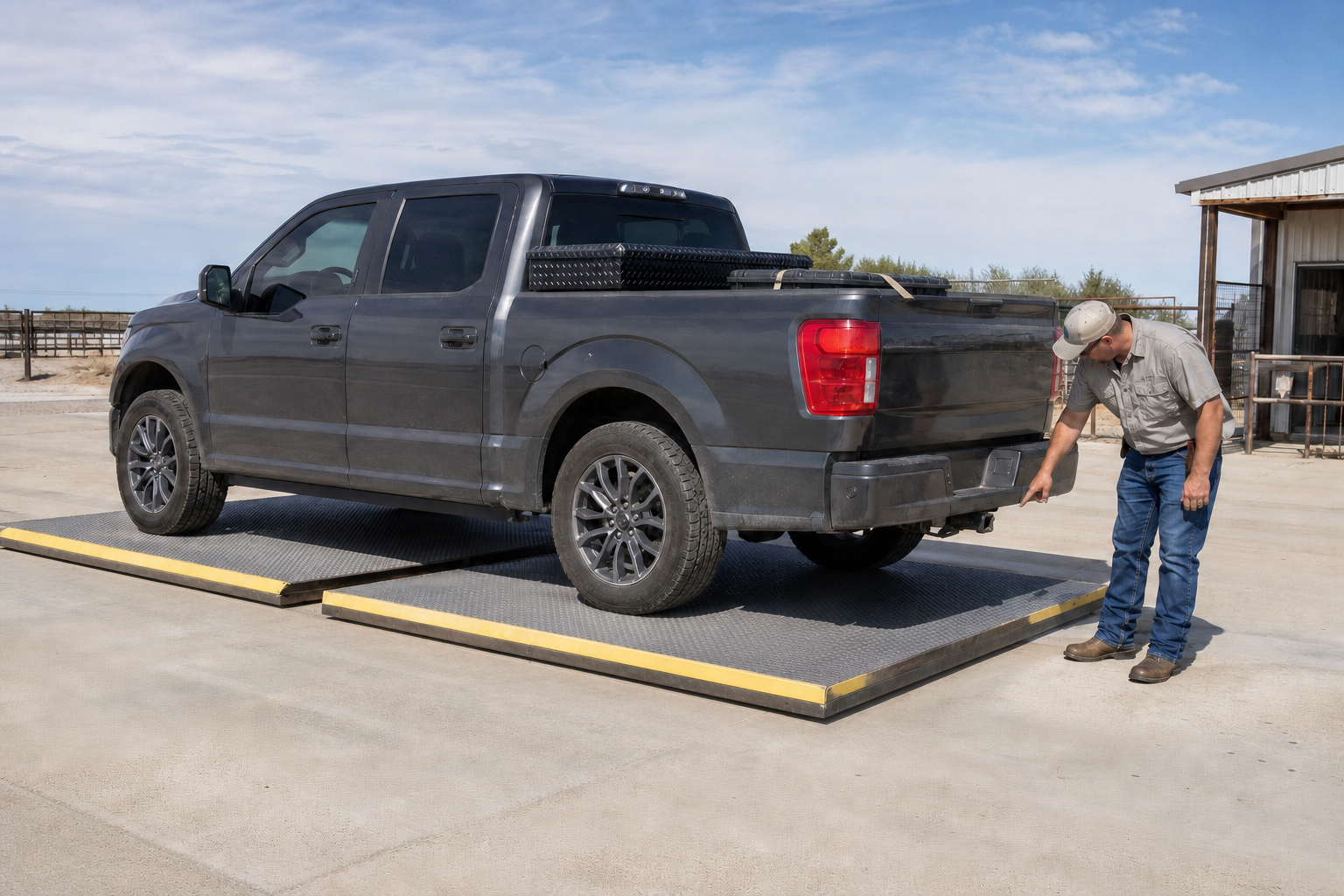
Arithmetic is most useful before loading, but a scale answers a different question: what does the truck weigh in the configuration that will leave the driveway? Fill fluids as they will be carried, place the usual occupants or an accurately represented equivalent aboard, secure the normal tools and cargo, and include the trailer connection if towing is part of the trip. A curb-weight estimate cannot substitute for that finished condition.
Ask for the whole vehicle weight and separate front- and rear-axle readings when the scale can provide them. The manufacturer’s loaded-vehicle weighing guidance explains why: a truck can remain within its gross vehicle weight rating while one axle exceeds its own rating. Compare the readings with the GVWR and the front and rear GAWR values for the exact truck, then check the applicable tire, wheel and hitch limits as separate boundaries.
Where the weight sits matters as much as the total. A dense tool chest against the tailgate, a hitch carrier behind the bumper or trailer tongue load can concentrate demand near the rear axle. Move cargo only to positions that the vehicle and restraint hardware are designed to accept. Heavy items should stay low and secured, but “better distributed” never makes an overloaded truck acceptable.
The scale also prevents false precision. An accessory catalog weight may help with planning, yet mounting brackets, contents, fluids and related hardware change the installed total. Preserve the scale ticket or a clear record of each reading, the date, fuel level, occupants, cargo and trailer state. Without that context, a number from one trip can be mistaken for the truck’s permanent empty baseline.
Change the Budget Before You Change the Load
Update the record whenever the build changes. A new tonneau cover may replace an old one; a steel toolbox may stay installed but carry different contents; a spare tire, bed rack or recovery board mount may move weight rearward. Enter the change before adding trip cargo, then repeat the scale check when the cumulative change is meaningful or the remaining margin becomes small.
Towing requires the same discipline. Trailer tongue or pin load is carried by the truck, while the receiver, ball mount and other connection hardware also have mass. Use the vehicle and hitch manufacturers’ limits for the exact setup and obtain a real loaded measurement when required. A generous tow rating does not create extra payload, and staying under a trailer rating does not authorize exceeding the truck’s rear-axle, tire or gross-vehicle limits.
Visible stance is not a measuring instrument. A level-looking truck can still be over a rating, while modest rear settling does not prove overload by itself. Helper springs, air springs and similar hardware may change ride behavior, but they do not rewrite the certified ratings on the vehicle labels. Treat handling changes, unusual tire heat, steering feel or braking distance as reasons to stop and reassess, not as a substitute for the calculation.
A useful payload budget belongs to one truck on one trip. It begins with that truck’s labels, names every person and piece of equipment already consuming capacity, and ends with a loaded scale record that separates the axles. Keeping that record current makes accessory choices easier: before the next toolbox, cover, rack or trailer is added, the owner can see what the truck is already carrying and which limit needs to be checked first.