
Pickup setup and safety
Safe Cab Access After a Suspension Lift: What to Measure Before the First Trip
A practical inspection for step height, tire clearance, and fixed or powered running boards.
A suspension lift can improve ground clearance, but it also changes how a driver and passengers enter the cab. The important question is not simply how tall the truck is. Safe, comfortable entry depends on the relationship between the ground, the step surface, the cab sill, the door opening, and the nearby tire and suspension hardware.
Before judging the new step-up height, keep the tire baseline tied to the truck rather than to appearance alone. NHTSA TireWise advises drivers to use the Tire and Loading Information label and the owner’s manual for the specified tire size and cold inflation pressure. That check belongs near the beginning because a tire change can alter both entry height and clearance around a step bracket.
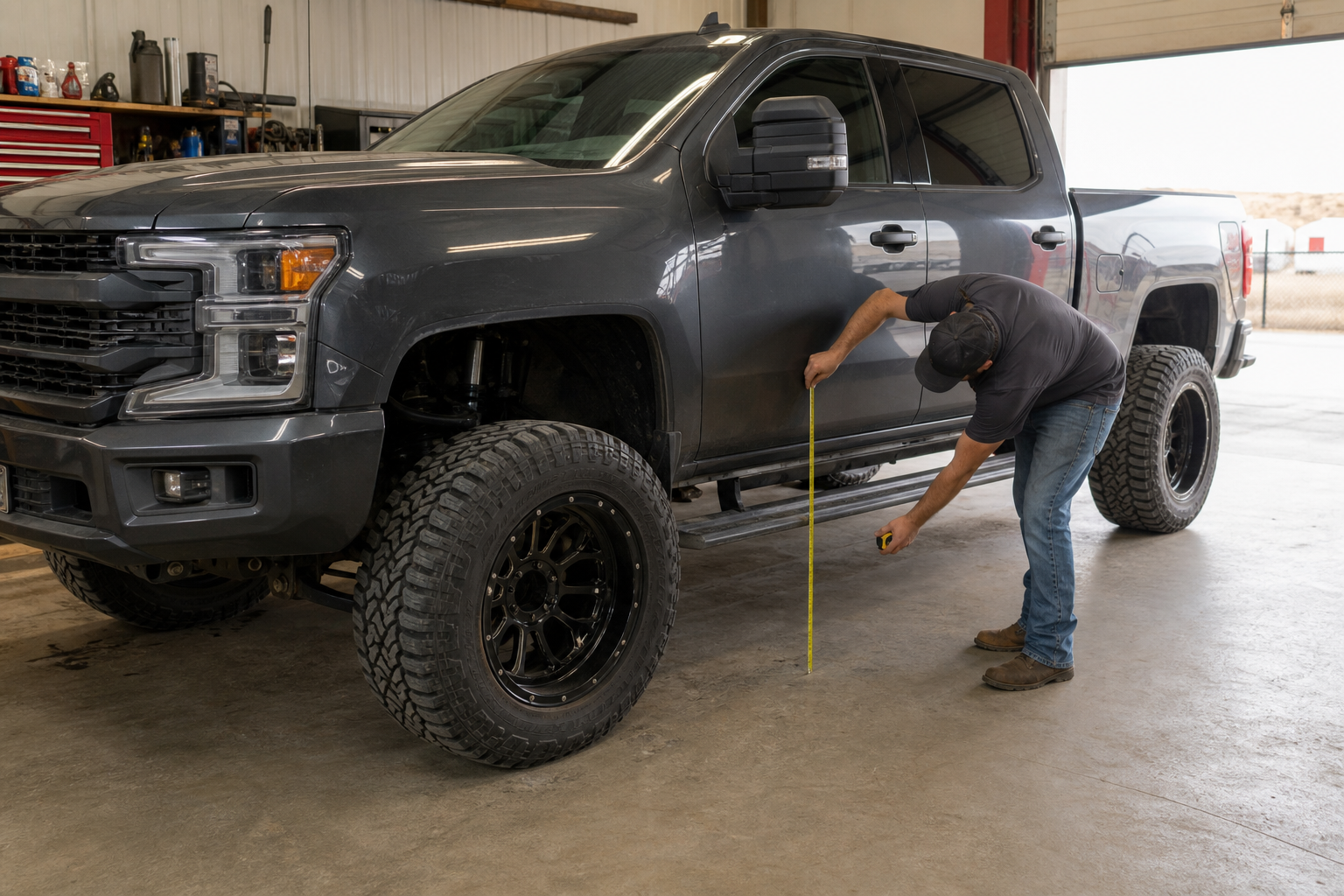
Establish Three Reference Measurements
Park on a firm, level surface, shift into Park, set the parking brake, and switch the engine off before working around the step or wheel opening. Then record three dimensions at each door that will be used regularly:
- Ground to step surface. Measure to the part of the tread where a boot naturally lands, not to the lowest edge of a decorative trim piece.
- Step surface to cab sill. This second rise is often the one that determines whether entry feels balanced or awkward.
- Step or bracket to nearby tire and bodywork. Check the outer step edge, mounting brackets, mud flaps, rocker trim, and the tire’s visible clearance.
Do not assume that the front and rear doors produce the same result. Cab shape, bracket location, and step length can change the usable landing area. Write the measurements down and photograph the ruler position so the same points can be checked after later service.
Treat Powered Steps as Moving Hardware
A fixed running board can be inspected in its normal position. A power step needs two inspections: fully deployed and fully retracted. The official Mopar power-side-step instructions describe deployment when a door opens and automatic retraction once the vehicle is moving above the specified low speed. That behavior makes a clean operating cycle part of the access check.
Open each door separately and watch the entire step movement from a safe distance. Confirm that the tread reaches a stable, repeatable position and retracts without contacting a bracket, mud flap, wiring loom, or added body trim. Listen for scraping or a change in motor sound. Dirt packed around pivots and bent mounting points deserve attention before anyone uses the step as a foothold.
Never place a hand or foot in the mechanism while testing it. If deployment is incomplete or inconsistent, stop the test and follow the step manufacturer’s service procedure rather than forcing the assembly.
Check the Lift, Tires, and Steps as One System
Accessory changes can interact even when each part fits by itself. A larger tire may reduce the space beside a forward step bracket. A relocated mud flap can move toward the tread at steering lock. A longer step can improve the landing area but leave less clearance to the front wheel opening.
The federal tire-information rule in 49 CFR § 571.110 is why the vehicle placard is a useful reference for tire size, loading, and cold inflation information. Compare the installed tire markings with that baseline, but remember that a placard check alone cannot prove modified-component clearance.
With the truck stationary, inspect both front wheels straight ahead and at full steering lock in each direction. Look for fresh rub marks, polished metal, displaced fasteners, stretched wiring, or a mud flap pushed toward the tread. Dynamic suspension travel cannot be recreated safely by leaning on a parked truck; if clearance is close or uncertain, have a qualified shop inspect it under controlled conditions.
Make the Human-Fit Test Repeatable
Once the hardware passes the parked inspection, test entry with clean, dry footwear and a stable handhold. The vehicle should remain off, in Park, with the parking brake set. Step onto the center of the tread rather than its outer edge and note whether the movement requires a jump, a sideways twist, or contact with the seat bolster.
Repeat the test at every commonly used door. A rear passenger may have a different handhold and a narrower landing area than the driver. Also consider normal use: work boots, wet soles, low light, carrying tools, or helping a child or an adult with limited mobility. The purpose is not to invent one universal “safe” height; it is to identify whether this truck’s entry sequence is stable and predictable for its actual users.
If the tread surface is worn smooth, loose, contaminated with oil, or too narrow for a secure landing, correct that problem before focusing on cosmetic alignment. Grip and rigidity matter more than whether the step appears perfectly centered from a distance.
Use a Short Road Test, Then Recheck Parked
After the parked checks, take a short, low-risk road test only if the step is secure and the steering path is clear. Listen for a new rattle, scrape, or vibration. Avoid using the road test to “see if it clears” when the parked inspection already shows a marginal gap.
Return to the same level surface and repeat the visual inspection. Verify that mounting points have not shifted and that a powered step still completes the same deploy-and-retract cycle. Fastener torque must follow the accessory or vehicle manufacturer’s specification; there is no safe universal torque value for every bracket and truck combination.
Recheck Whenever the Geometry Changes
Keep the measurements and photographs with the truck’s service records. Repeat the inspection after changing tire size, adjusting suspension height, replacing a step or bracket, adding a mud flap, or noticing new contact marks. Recheck after any impact near the rocker panel or wheel opening as well.
A lifted pickup does not need to be difficult to enter. The reliable approach is to measure the two-step climb, verify the moving hardware, preserve tire and steering clearance, and test the entry sequence with the people who actually use the truck. Those checks turn a vague concern about height into a practical record that can be compared after every future modification.